
What is Astronaut Crash Game?
Astronaut Crash Game is a lightweight rocket-style crash simulator where each round starts with a multiplier at 1.00× and climbs until the system triggers a sudden stop. You place your stake, watch the ascent, and decide when to pull out. Built with a provably fair algorithm, medium–high volatility, and RTP that can reach 98%, it’s a straightforward timing-based title from 100HP Gaming without side bonuses or complicated features.
100HP Gaming Astronaut Game Features
100HP’s take on this crash format keeps everything focused on the multiplier curve — fast rounds, clear controls, and a math model that operators can tune toward higher RTP bands. The game avoids extra layers like bonus rounds, which helps Astronaut stay lightweight even on older phones.
| Aspect | Details |
| Developer | 100HP Gaming |
| Game Type | Crash / rocket-rise mechanic |
| RTP Range | Up to 98% |
| Volatility | Medium–High |
| Max Win | ~₹8,30,000 (or 50,000×, casino-dependent) |
| Max Multiplier | x50,000 |
| Min/Max Bet | ₹10 – ₹12,500 (varies by operator) |
| Bet Panels | Two independent betting stations |
| Cashout Tools | Manual, auto-cashout, Take Half |
| Fairness | Provably Fair engine |
| Platforms | Mobile and desktop |
| Demo Mode | Available on most Indian platforms |
RTP of Astronaut Game Aviator
Astronaut Game Aviator runs on an RTP band that can reach 98%, depending on how the operator configures the math. In simple terms, RTP shows how much the game is designed to return over a long stretch of rounds — not what happens in a single session, because crash games still have sharp volatility.
To make it clearer, here’s a quick example:
- If the RTP is set to 98%, then out of every ₹1,00,000 wagered across thousands of rounds, the long-term theoretical return is roughly ₹98,000.
- For a smaller sample:
- Stake: ₹500
- RTP: 98%
- Expected long-term return: ₹500 × 0.98 = ₹490
Of course, crash titles swing harder than slots — you might hit a 200× run in one round and then see several early crashes after that. RTP shows the math direction, not the session outcome.
Betting Limits for Indian Players
In most Indian casinos, Astronaut supports a wide betting spread so both cautious and high-risk players can participate. Stakes usually start around ₹10 and can go up to ₹12,500 per panel, giving room for either slow bankroll testing or aggressive two-panel setups.
For example, a player running dual bets might place:
- ₹50 on the first panel with auto-cashout at 2.00×
- ₹200 on the second panel aiming for a manual take above 10×
This mix lets Indian players balance safety and higher-risk shots within the same round, which is one of the reasons Astronaut crash game 100HP performs well on local platforms.
How to Play – Rules and Gameplay
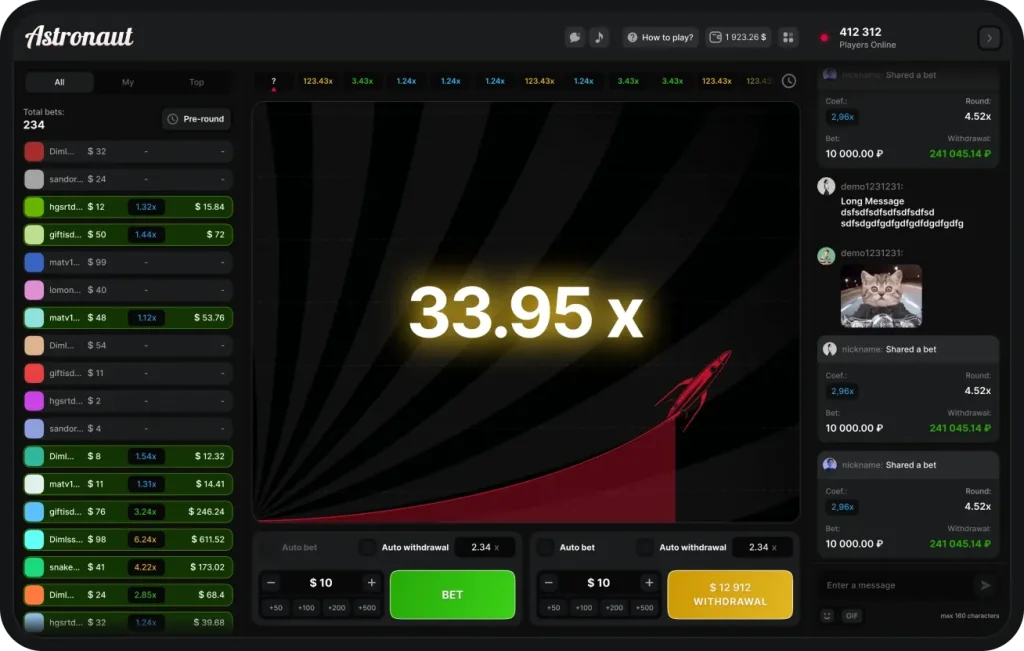
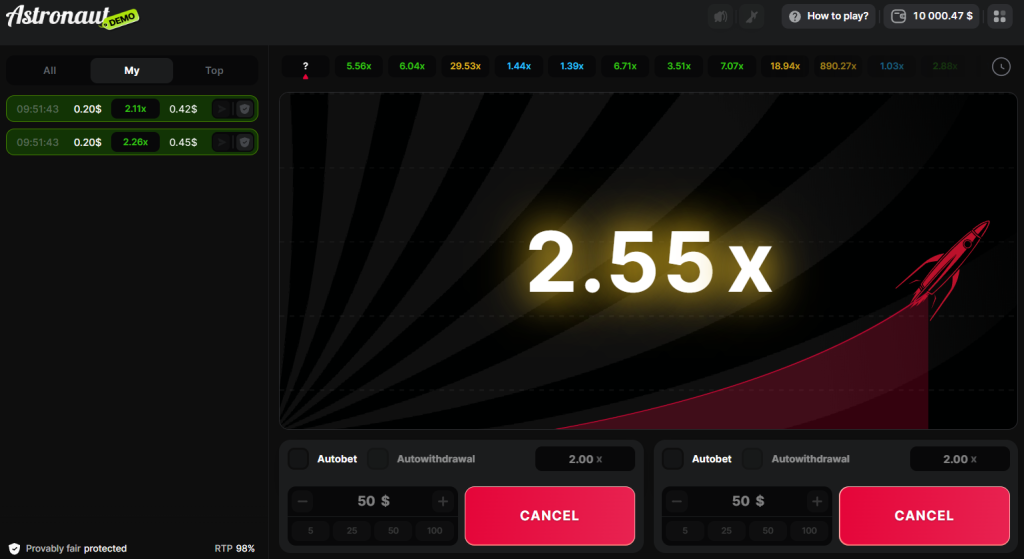
The gameplay flow in Astronaut stays minimal: you choose your stake, wait for the rocket to launch, and decide when to exit the round. The multiplier starts at 1.00× and climbs until the system triggers a crash. If you cash out before that moment, you lock in the shown multiplier; if not, the stake is lost. Players in India often test short cycles first — for example, running a few rounds at 1.20×–1.50× just to see how early the rocket tends to burst on that specific operator setup.
Autobet and Cashout
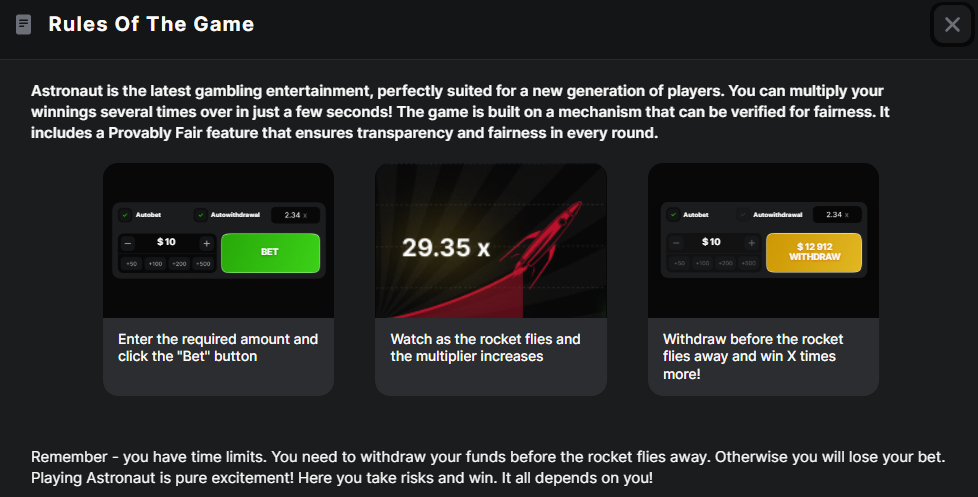
Autobet allows the game to place stakes automatically every round, which helps keep decisions consistent. Paired with auto-cashout, it becomes a discipline tool: you set a multiplier (say 2.00× or 3.50×) and the system pulls winnings the moment that value appears. Many players combine this with manual cashout on the second panel — for example, auto-cashout at 1.80× on Bet A, while manually chasing 8×–15× on Bet B when the game feels “long-running.”
This mix reduces decision fatigue and keeps the risk profile predictable.
Astronaut Bet Stats
Astronaut includes a built-in stats feed showing recent crash points, highest multipliers, and round frequency. While it doesn’t predict outcomes (the game is provably fair and fully random), the stats help players understand rhythm. For example, if the last five rounds ended below 1.30×, some players lower their stakes or switch to safer auto-cashouts. Others take the opposite path — keeping a tiny stake and waiting for a rare higher run like 50×, 100×, or, occasionally, the upper-end spikes that justify the x50,000 ceiling.
Betting Modes of Astronaut Crash Game
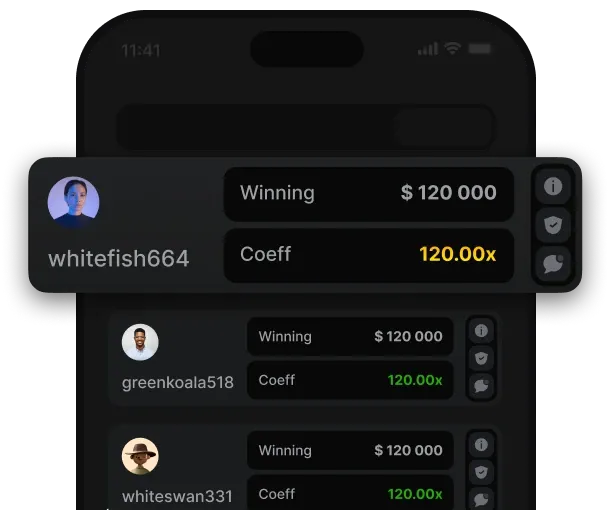
Astronaut betting gives players two pathways: a safe environment to practice the crash curve, and a real-money version where timing meets actual payout potential. Both modes mirror each other in volatility and multiplier behavior, so the learning you do in one carries straight into the other.
Online Free Astronaut Demo
The free demo is designed specifically for practice, letting players get a feel for the crash curve before risking money. Most platforms unlock it without registration, and it mirrors the real version in every technical aspect — same volatility, RTP settings, dual-bet layout, and the full x50,000 multiplier ceiling.
Key points of the demo mode include:
- No deposit needed to start
- Identical game math and crash behavior
- Safe environment to test short cashouts (1.20×–2.00×)
- Useful for reading streaks and early-crash patterns
- Allows practice with two-panel strategies without spending rupees
Indian Real Money Casino Play
Real-money play follows the same rules but adds the financial swing behind every decision. Indian players usually start around ₹10 per panel and adjust upward once they understand their preferred cashout range. Since the volatility is medium–high, payouts can spike quickly in long rounds, especially when running mixed strategies like safe auto-cashout on one panel and manual high-risk chasing on the other.
Astronaut Game Aviator Deposits
Depositing for Astronaut Game Aviator is usually quick and flexible across Indian casinos. Most platforms integrate payment options that work well for small entry stakes (₹10–₹200) and high-roller limits alike. The deposit flow is generally straightforward: choose a method, confirm the amount, and the balance updates almost instantly.
Common deposit methods for Indian players include:
- UPI apps (Google Pay, PhonePe, Paytm) – instant credit
- NetBanking / IMPS – usually under 1–3 minutes
- Debit/Credit Cards – processing depends on the bank
- Wallets (Airtel Money, JioMoney) – near-instant
- Crypto (on select casinos) – varies by network
Most casinos require a minimum deposit between ₹300–₹500, though some allow ₹100 for new accounts. Once the payment is approved, Astronaut becomes available under the crash or instant-win category, and you can start with either single-panel or dual-panel bets right away.
Withdrawal of Funds
Withdrawals follow the same channels but usually take longer due to verification steps. Indian casinos offering Astronaut crash game online generally process withdrawals after KYC, and the speed depends on the selected method.
Average payout times:
- UPI / IMPS: 5 minutes to 2 hours
- NetBanking: 2–6 hours
- Wallets: instant to 1 hour
- Crypto: depends on blockchain traffic (5–30 minutes typical)
A typical withdrawal path looks like this:
- Choose your payout method.
- Enter the amount (often min. ₹500–₹1,000).
- Submit request → casino verifies → funds released.
Most platforms notify you via in-app message or email once the payout is approved. If you used dual-bet strategies in Astronaut and built up small wins across multiple sessions, cashing out regularly helps avoid large volatility dips before withdrawal time.
Android/iOS App Adaptation
Astronaut runs smoothly on both Android and iOS because the game is built as a fully responsive browser title — the mobile version adjusts to screen size, touch controls, and shorter session styles without losing any features. You don’t need a separate Astronaut APK to test it: the free demo on our page is already mobile-optimized, so players can practice directly in the browser with the exact same math model, volatility, and x50,000 ceiling as the real-money version.
As for app-based play, Indian casinos usually integrate Astronaut inside their own casino apps, not as an individual standalone app. Once you install the casino’s official Android or iOS application, Astronaut appears under “Crash,” “Aviator-type,” or “Instant Games,” and the gameplay is identical to the browser version — dual-bet panels, auto cashout, Take Half, all included.
Astronaut Crash Game Strategies
Because Astronaut is a crash game with medium–high volatility and a max ceiling of x50,000, strategies here focus more on managing timing, stake sizing, and the two-panel layout rather than “predicting” anything. The game is provably fair — each round is independent — so the practical approach is to control exposure and use the tools that 100HP Gaming built into the system.
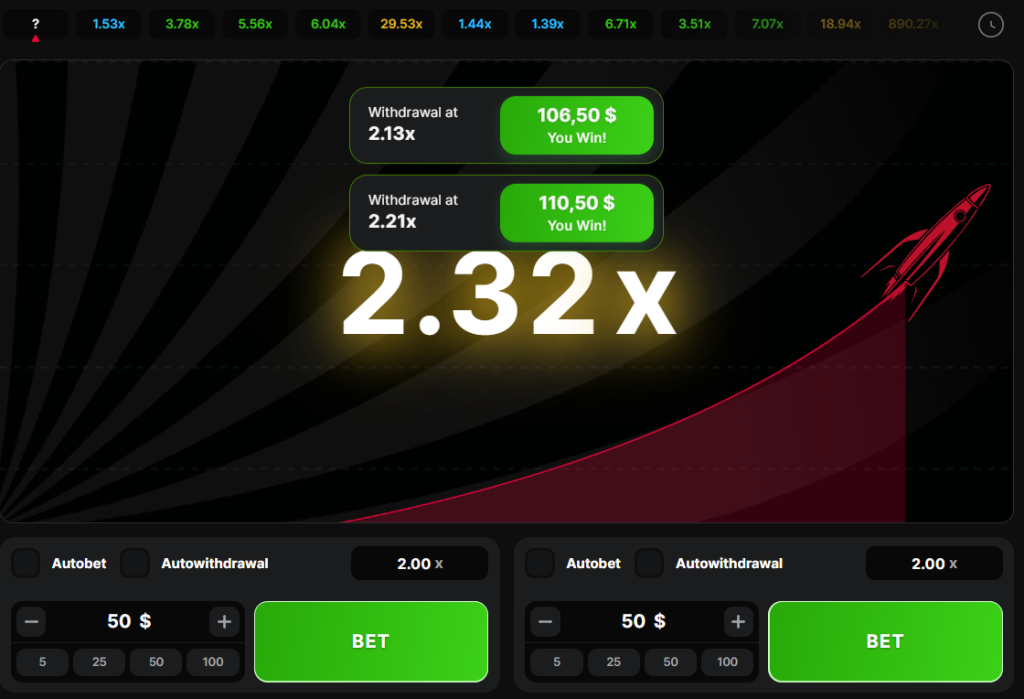
Below are strategies adapted specifically for Astronaut’s mechanics:
- Short-Cycle Cashouts (Low-Risk Approach)
A large share of Indian players start with quick exits around 1.20×–1.80×. This approach works because:
- early crashes happen often, but multipliers above 1.20× are still common
- dual-panel setups let one panel secure small returns
- bankroll lasts longer during volatility spikes
Example:
- Panel A: ₹50 → auto-cashout at 1.50×
- Panel B: ₹20 → manual chase if the round “feels long”
This keeps the main stake protected while still running occasional higher attempts.
- Mixed Volatility Using Dual Bets
Astronaut’s dual-bet feature is its biggest strategic layer. A popular pattern is:
- Safe bet: small stake, fixed auto-cashout (2× or below)
- High-risk bet: separate stake without auto-cashout, manually waiting for 8×–20× runs
This spreads risk and allows both conservative and aggressive lines within the same round.
- Rhythm Observation (Not Prediction)
The stats panel shows recent crash multipliers — not to “forecast” the next round, but to understand short-term streaks. Players often adjust like this:
- If the last 5 rounds ended below 1.30×, reduce stakes or switch to quick cashouts
- If several medium runs occurred (2×–5×), avoid chasing too high immediately
- After a deep cluster of low crashes, some players risk a small “shot” because historically, long runs do appear, but risk stays high
It’s not prediction — it’s stake adjustment based on comfort with volatility.
- Take-Half Safety Net
The Take Half option helps control exposure. Example:
- At 4×, take 50% profit
- Let the remaining 50% ride toward a higher target
This keeps part of the win secured while allowing a gamble for more. Works well when the rocket climbs slowly and looks stable.
- Bankroll Cycling
Since Astronaut is medium–high variance, structuring sessions matters more than “hunting big wins.” Practical cycle:
- Set aside a session bankroll (e.g., ₹1,000)
- Use fixed bet sizing (₹20–₹50 per panel, depending on budget)
- Cash out after reaching +20–30% gain
- Stop after a -20% drop to avoid chasing losses
Crash games punish emotional decisions more than slots, so controlled pacing is essential.
- High-Risk Long-Run Hunting
Some players intentionally target rare multipliers like 50×, 100×, or more. This only works with:
- minimal stakes
- long bankroll
- acceptance of frequent losses
Since Astronaut can theoretically climb to x50,000, long-run hunting is possible but should be done with micro-stakes only.
Licensing and Legality in India
Astronaut crash game online is distributed by 100HP Gaming, a studio that operates through internationally recognized licensing frameworks. The game itself is usually offered under the casino’s main license — meaning legality depends on the platform you choose rather than the game alone. Most Indian-facing casinos that host Astronaut run under offshore regulatory bodies such as Curaçao or Anjouan, which allow real-money crash titles and ensure that the provably fair engine is audited before integration.
In India, real-money online gaming exists in a state-dependent legal landscape:
- Some states restrict real-money games entirely.
- Others allow skill-based games but don’t explicitly regulate crash or instant-win formats.
- Offshore casinos operate in the “permitted but not domestically regulated” category, making access widely available to Indian players.
For practical use: if the casino is licensed, transparent about KYC/AML, and supports responsible-play tools, Astronaut is considered safe to access. The demo version on our page remains fully legal nationwide, as it doesn’t involve real money.
Keep Responsible Play
Astronaut’s fast rounds and sharp volatility make it important to treat each session with control. Set a clear budget, use small stakes when testing new patterns, and avoid chasing losses after early crashes. Auto-cashout and the Take Half option can help keep decisions steady. If the game stops feeling comfortable, pause, step away, and return only when you’re fully in control.
FAQ
What type of game is Astronaut?
Astronaut is a crash-style rocket game where a rising multiplier keeps climbing until the system triggers a sudden stop, and the goal is to cash out before the burst.
How to play Astronaut crash game?
You pick your stake, wait for the rocket to launch, and cash out at any moment before the crash, with the option to run two bets at once for mixed strategies.
Does every second increase the multiplier?
The multiplier doesn’t rise on a per-second timer; it climbs according to the internal math model, which can move slowly in some rounds and spike rapidly in others.
Can I use auto-cashout?
Yes, you can set a target multiplier such as 1.50× or 3× and the system automatically takes your winnings the moment that number appears.
Does Astronaut support simultaneous bets?
It does, thanks to two independent bet panels that let players combine safer exits with high-risk attempts within one round.
Is the game provably fair?
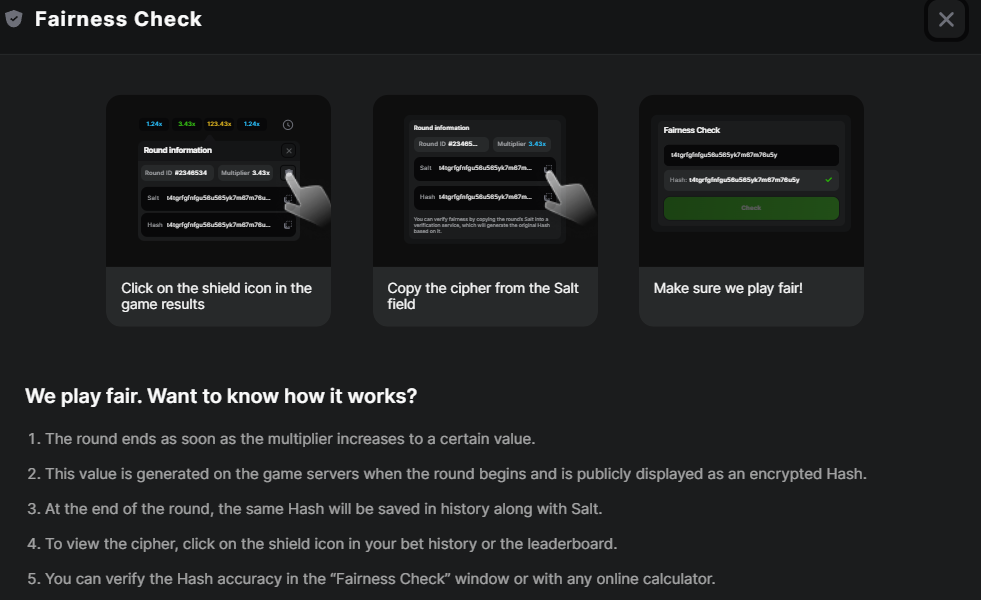
Yes, Astronaut crash game uses a provably fair algorithm, so each crash point is generated independently and can be verified using round seeds.
Is there a maximum multiplier?
The game’s ceiling reaches x50,000, although high-end runs like this are extremely rare and mostly visible in long-term statistics.
What is the minimum and maximum bet?
Most Indian casinos set the range from about ₹10 on the low end to around ₹12,500 per panel, depending on their internal limits.